Mineral Rights Value by State: What 2026 Lease Auctions Paid Per Acre
What are mineral rights worth in your state? The clearest public evidence is what oil and gas companies paid at state and federal lease auctions in 2026. Here is what those sales show, state by state and county by county, with the official source for every number.
Updated 2026-11-11 · 12 min read
What the public numbers measure
This guide to mineral rights value by state uses one kind of public data: oil and gas lease auctions run by state land offices and the U.S. Bureau of Land Management (BLM). When a state or the federal government leases minerals it owns, it auctions the lease and publishes the winning bids. Those results are the most direct public per-acre prices for oil and gas rights, and every number below links to the agency that published it.
Read them with three things in mind:
- A lease bonus is not a sale price. The bonus is a one-time payment for the right to drill for a set number of years. The owner keeps the minerals and is paid a royalty if a well is drilled. Selling minerals outright is a different deal, priced differently.
- Public minerals are a sample. They sit wherever the state or federal government happens to own minerals, so a county figure can rest on one or two tracts.
- Averages hide the range. In the same 2026 auction, one county drew thousands of dollars an acre and another drew a few dollars. Your county matters more than your state.
Per-acre averages marked our math are the agency's published bonus totals divided by the acres leased. Figures an agency published itself are credited to that agency. Tracts that drew no bids are left out.
Mineral rights value by state: 2026 results at a glance
State land office auctions in 2026, through the latest results each agency had posted by November 11, 2026:
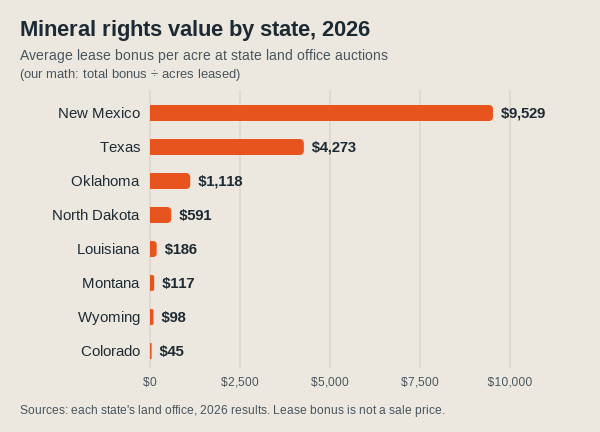
| State | Agency | 2026 sales | Acres leased | Bonus paid | Average per acre (our math) | Highest per acre |
|---|---|---|---|---|---|---|
| New Mexico | State Land Office | 10 (Jan–Oct) | 12,709 | $121.1 million | $9,529 | $37,500 |
| Texas | General Land Office | 2 (May, Oct) | 5,149 | $22.0 million | $4,273 | $15,100 |
| Oklahoma | Commissioners of the Land Office | 3 (Mar, Jun, Sep) | 14,158 | $15.8 million | $1,118 | $20,125 |
| North Dakota | Department of Trust Lands | 2 (Mar, Oct) | 35,661 | $21.1 million | $591 | $6,001 |
| Louisiana | State Mineral and Energy Board | 8 (Jan–Aug) | 16,681 | $3.1 million | $186 | not published per lease |
| Montana | Department of Natural Resources and Conservation | 3 (Mar, Jun, Sep) | 30,840 | $3.6 million | $117 | $4,505 |
| Wyoming | Office of State Lands and Investments | 2 (Mar, Jul) | 102,454 | $10.0 million | $98 | $4,611 |
| Colorado | State Land Board | 2 (Apr, Aug) | 20,903 | $930,947 | $45 | $302 |
Ohio's state commission publishes bids rather than a sale total (see Ohio), Utah's state results were not reachable (see Utah), and six states had no 2026 public auction results we could find (see the other states).
Federal BLM sales in 2026, using the BLM's published totals (bonus bids plus first-year rentals):
| BLM sale | Acres leased | Total receipts | Per acre (our math) |
|---|---|---|---|
| New Mexico and Texas, May 20 | 33,530 | $4.0 billion | $119,533 |
| New Mexico and Oklahoma, Jan 6 | 20,399 | $326.8 million | $16,021 |
| New Mexico, Oklahoma and Texas, Aug 20 | 20,334 | $139.0 million | $6,837 |
| Ohio (Wayne National Forest), Sep 15 | 2,777 | $11.1 million | $3,996 |
| Utah, Mar 31 | 68,632 | $56.4 million | $822 |
| Colorado, Sep 10 | 14,212 | $4.7 million | $334 |
| Wyoming, Jun 9 | 114,439 | $34.7 million | $303 |
| Colorado, Jun 16 | 134,173 | $35.3 million | $263 |
| Wyoming, Mar 3 | 69,134 | $14.5 million | $210 |
| Colorado, Mar 31 | 42,532 | $8.1 million | $190 |
| Utah, Sep 22 | 34,596 | $4.5 million | $130 |
How much are mineral rights worth in Texas?
The Texas General Land Office (GLO) leases state-owned minerals by sealed bid. At its two 2026 sales, on May 12 and October 20, high bids came in on 26 tracts covering 5,149 acres, totaling $22.0 million, or about $4,273 an acre (our math). The GLO calls its bid tabulation preliminary: high bids are not final until the School Land Board accepts them.
Nearly all of that money was for the Permian Basin. Twenty-two tracts in Reeves, Ward, Pecos, Culberson, Midland and Dawson counties averaged about $4,376 an acre. Ward County tracts averaged about $5,855 an acre across nine tracts, and Reeves County about $3,624 across seven. A 160-acre Midland County tract drew $7,500 an acre, and 32.76 acres in Dawson County drew the year's top bid of $15,100 an acre. Even inside the Permian the range was wide: one 164-acre Pecos County tract drew about $73 an acre.
The four tracts outside the Permian were small. A 100-acre Galveston County tract drew $200 an acre and 25.65 acres in Gregg County drew about $755. See also Texas mineral rights by county and selling mineral rights in Texas.
How much are mineral rights worth in North Dakota?
The North Dakota Department of Trust Lands auctions leases on state school-trust minerals and publishes the bonus per acre for every tract. Its March and October 2026 auctions leased 370 tracts covering 35,661 net mineral acres for $21.1 million, about $591 an acre on average (our math).
The statewide average says little, because the Bakken core and the rest of the state are different markets:
- Mckenzie County: 24 tracts averaged about $3,862 an acre, with a high of $6,001.
- Williams County: 25 tracts averaged about $1,923 an acre (high $4,503).
- Burke County: 33 tracts averaged about $936 an acre (high $5,170). Mountrail County's two tracts averaged about $871.
- Dunn and Billings counties averaged about $193 and $134 an acre.
- In the southwest, 222 tracts in Slope County, Golden Valley and Bowman counties averaged between $3 and $11 an acre.
More detail: North Dakota mineral rights by county and selling mineral rights in North Dakota.
What is the average price per acre for mineral rights in Ohio?
Ohio leases oil and gas under state parks, wildlife areas and highway right-of-way through its Oil and Gas Land Management Commission, which posts the bids it receives. At its June 29, 2026 meeting the commission considered bids for nine large tracts under the Egypt Valley and Jockey Hollow wildlife areas and Salt Fork State Park, in Belmont County, Harrison County and Guernsey County counties.
Those 53 offers ran from $4,000 to $17,500 an acre. The highest offer on each tract ranged from $7,500 to $17,500 an acre, most with a 12.5% royalty. Smaller tracts along state highways and at a state prison drew offers of $500 to $3,500 an acre. These are the offers the commission weighed; the terms it awarded can differ.
The federal government leased Ohio minerals too. On September 15, 2026 the BLM leased 40 parcels covering 2,777 acres in the Wayne National Forest for $11,097,693 in total receipts, about $3,996 an acre (our math). See Ohio mineral rights by county and selling mineral rights in Ohio.
How much are mineral rights worth in Wyoming?
Wyoming's Office of State Lands and Investments auctions state trust-land leases three times a year. Its March and July 2026 auctions leased 268 parcels covering 102,454 acres for $10.0 million in bonus, about $98 an acre (our math). Leases run five years at $1 an acre rent with a one-sixth or one-eighth royalty, and the minimum bid is a $1 an acre bonus.
Most of that acreage drew little: 68 Goshen County parcels averaged about $2 an acre. The Powder River Basin is where bidding was strong. Converse County parcels averaged about $1,688 an acre (high $4,556), and Campbell County parcels about $348 (high $4,611). Sweetwater County, with the most leased acreage, averaged about $156.
Federal minerals cover far more of Wyoming. The BLM's March 3, 2026 sale leased 69,134 acres for $14,487,361 and its June 9 sale leased 114,439 acres for $34,706,638 in total receipts, about $210 and $303 an acre (our math). See Wyoming mineral rights by county and selling mineral rights in Wyoming.
How much are mineral rights worth in Oklahoma?
Oklahoma's Commissioners of the Land Office (CLO) lease school-trust minerals in sealed-bid sales and publish every bid. Its March, June and September 2026 sales drew high bids on 150 tracts covering 14,158 net acres, totaling $15.8 million, or about $1,118 an acre (our math).
Western Oklahoma led. Roger Mills County tracts averaged about $2,556 an acre in March and Caddo County tracts about $2,231 in June. Beckham, Custer and Dewey county tracts mostly averaged between about $650 and $2,700 an acre. The single highest bid was $805,000 for 40 acres in Grady County in September, or $20,125 an acre.
Elsewhere bids were far lower: Kay County tracts averaged about $55 an acre, Oklahoma County about $73 and Beaver County, in the Panhandle, about $33. See Oklahoma mineral rights by county and selling mineral rights in Oklahoma.
How much are mineral rights worth in New Mexico?
New Mexico's State Land Office holds an oil and gas lease sale every month and posts full results. From January through October 2026 it leased 72 tracts covering 12,709 acres for $121.1 million, about $9,529 an acre (our math), the highest of any state land office in this guide. The top tract drew $37,500 an acre in March. Every month averaged above $2,000 an acre, and five of the ten averaged above $9,000.
Federal sales of New Mexico minerals set records in 2026. The BLM's January 6 sale leased 20,399 acres in New Mexico and Oklahoma for $326.8 million; the BLM put the average bid at over $16,000 an acre and reported $218,751 for a single acre, its highest since at least 1987. Its May 20 sale leased 33,530 acres in New Mexico and Texas for about $4.0 billion, about $119,533 an acre (our math). See New Mexico mineral rights by county, including Lea County and Eddy County, and selling mineral rights in New Mexico.
How much are mineral rights worth in Colorado?
Colorado's State Land Board auctions leases in April, August and December. Its April and August 2026 auctions leased 51 tracts covering 20,903 acres for $930,947 in bonus, about $45 an acre (our math). Weld County had most of the leased acreage, and its top bid was $302 an acre. Eleven tracts leased for the rental alone, with no bonus, and 16 drew no bids. State leases start at a 20% royalty, which drops to 18.75% if a tract does not sell.
Federal BLM sales in Colorado on March 31, June 16 and September 10, 2026 brought about $190, $263 and $334 an acre in total receipts (our math). See Colorado mineral rights by county and selling mineral rights in Colorado.
How much are mineral rights worth in Montana?
Montana's Department of Natural Resources and Conservation (DNRC) holds quarterly lease sales on state trust land. Its March, June and September 2026 sales leased 64 tracts covering 30,840 acres for $3.6 million, about $117 an acre (our math). DNRC's own averages for the three sales were $64.01, $59.18 and $314.57 an acre.
Strong bids came only from northeastern Montana: $4,005 an acre for 130 acres in Richland County in March, $4,505 and $2,355 an acre for 80-acre tracts in Roosevelt County in June, and $2,470 an acre for 866.52 acres in Sheridan County in September. Most other tracts went for $1.50 to $10 an acre. See Montana mineral rights by county and selling mineral rights in Montana.
How much are mineral rights worth in Louisiana?
Louisiana's State Mineral and Energy Board leases state-owned minerals at monthly sales and reports each month's bonus, lease count and acreage. From January through August 2026 it sold 54 leases covering 16,681 acres for about $3.1 million in bonus, about $186 an acre (our math). Monthly averages swung from about $35 an acre in February, when 8,300 acres sold, to $1,750 in March, when a single 60-acre lease sold. See Louisiana mineral rights and selling mineral rights in Louisiana.
How much are mineral rights worth in Utah?
Utah's Trust Lands Administration website sits behind a bot check, so we did not use it. Federal results are public: the BLM's March 31, 2026 Utah sale leased 68,632 acres for $56.4 million, about $822 an acre, and its September 22 sale leased 34,596 acres for $4,492,000, about $130 an acre (our math, from total receipts). See Utah mineral rights by county, including Duchesne County and Uintah County, and selling mineral rights in Utah.
Pennsylvania, West Virginia, Kansas and the other states
For six of the 16 states we cover, we found no 2026 public lease auction results. Here is what is public instead:
- Pennsylvania: no auctions, but the Pennsylvania Game Commission negotiates leases under state game lands and publishes the terms. On July 10, 2026 it approved a 10-year agreement for about 206 net acres under State Game Land 259 in Armstrong County at a $2,500 per net acre bonus and an 18% royalty, and an amendment in Butler County at $1,250 per net acre for Marcellus rights and $250 per net acre for the Burket formation. See selling mineral rights in Pennsylvania.
- West Virginia: we found no 2026 lease bid openings for state-owned minerals. See selling mineral rights in West Virginia.
- Kansas: no 2026 state results. The BLM has scheduled a November 18, 2026 sale of 30 parcels in New Mexico, Oklahoma, Texas and Kansas. See selling mineral rights in Kansas.
- Arkansas: the Commissioner of State Lands leases state-owned minerals by sealed bid; we found no 2026 bid results posted. See selling mineral rights in Arkansas.
- Alabama: the State Lands Division posted a June 2026 bid notice for one 15.8-acre tract under the Conecuh River in Escambia County; we found no published result. See selling mineral rights in Alabama.
- Mississippi: no 2026 state results. A March 2026 BLM sale leased 506 acres across Arkansas, Michigan, Mississippi and Louisiana for $267,047 in total, without a per-state split. See selling mineral rights in Mississippi.
In these states, nearby drilling permits and recent leasing in your own county are the best guide. Each county page shows recent permit activity.
From a lease bonus to what your minerals are worth
A public lease bonus tells you what an operator paid for a few years' right to drill nearby. It does not tell you what someone will pay to own your minerals outright, and it does not apply to minerals that already have a producing well.
- Non-producing minerals: buyers often start from the going lease bonus in the area, then adjust for how close drilling is. Our mineral rights value calculator takes a lease bonus offer as an input and shows the math it uses.
- Producing minerals: value follows the royalty income, not the acreage. Use the calculator's producing option with your average monthly royalty.
- Your own tract: the county page for your area shows recent permits and activity, and our mineral rights value guide explains the factors that move a price up or down.
When you want a firm number rather than a benchmark, request a no-obligation cash offer below.
Sources
Official results and announcements used in this guide, all published in 2026:
- Texas General Land Office: past bid sale tabulations (May 12 and October 20, 2026)
- North Dakota Department of Trust Lands: March and October 2026 auction results
- Oklahoma Commissioners of the Land Office: March, June and September 2026 bid tabulations
- New Mexico State Land Office: January–October 2026 full results
- Wyoming Office of State Lands and Investments: auction information and March and July 2026 results
- Montana DNRC: 2026 quarterly lease sale results
- Colorado State Land Board: April and August 2026 auction results
- Louisiana State Mineral and Energy Board: monthly lease sale results, January–August 2026
- Ohio Oil and Gas Land Management Commission: bids for the June 29, 2026 meeting
- Pennsylvania Game Commission: July 10, 2026 meeting agenda
- BLM: January 6, 2026 New Mexico and Oklahoma sale, May 20 New Mexico and Texas sale, August 20 sale
- BLM Wyoming: March 3, 2026, June 9, 2026
- BLM Colorado, Nevada and Utah: March 31, 2026, Colorado June and September 2026, Utah September 22, 2026
- BLM Ohio: September 15, 2026 Wayne National Forest sale, BLM Eastern States: March 12, 2026
Frequently asked questions
Which state pays the most per acre for mineral rights?
Going by 2026 public lease auctions, New Mexico. Its State Land Office leased 12,709 acres for $121.1 million from January through October, about $9,529 an acre, and a federal BLM sale in January set a record of $218,751 for a single acre. Texas Permian tracts averaged about $4,376 an acre at the Texas General Land Office's 2026 sales.
Is a lease bonus the same as what my mineral rights are worth?
No. A lease bonus is a one-time payment for the right to drill for a few years, and the owner keeps the minerals and a royalty. A sale transfers ownership for good, so it is priced differently. Lease bonuses near your tract are a useful benchmark for non-producing minerals, not a sale price.
Why did some public leases sell for $1 or $2 an acre?
In areas with no drilling interest, tracts often draw only the minimum bid. Wyoming's minimum is a $1 an acre bonus, and in 2026 most Goshen County, Wyoming parcels and most southwestern North Dakota tracts leased for a few dollars an acre, while Bakken and Powder River Basin tracts drew thousands.
Where can I look up lease sale results for my state?
State land offices post them: the Texas General Land Office, North Dakota Department of Trust Lands, Oklahoma Commissioners of the Land Office, New Mexico State Land Office, Wyoming Office of State Lands and Investments, Montana DNRC, Colorado State Land Board and Louisiana's State Mineral and Energy Board. The BLM posts federal sale results. Links are in the Sources section of this guide.
How much are non-producing mineral rights worth per acre?
It depends on drilling nearby. In 2026 public auctions, leases for non-producing acreage ran from a few dollars an acre in quiet areas to more than $5,000 in the Bakken core and the Texas Permian, and higher still in New Mexico. Use the lease bonus in your county as a starting point and the value calculator to turn it into a range.